
English| EUR
Suggested for you
More currencies
Choose a language
Not all elephant encounters in northern Thailand operate under the same welfare standards. The distinction between genuine sanctuaries and entertainment venues lies in daily practices, from feeding protocols to physical contact guidelines. This guide explains the ethical framework visitors should expect when choosing a conservation-focused experience.
Quick answer
Ethical elephant sanctuary and bamboo rafting Chiang Mai programs prohibit riding, eliminate bull hooks, and provide rescued elephants with natural foraging environments spanning 250 acres of protected jungle. The half-day conservation program at 1,900 THB includes observation-based interaction, mud bathing supervised by mahouts, and educational briefings on Southeast Asian elephant welfare. Genuine sanctuaries prioritize herd dynamics over entertainment value and maintain transparent veterinary records.
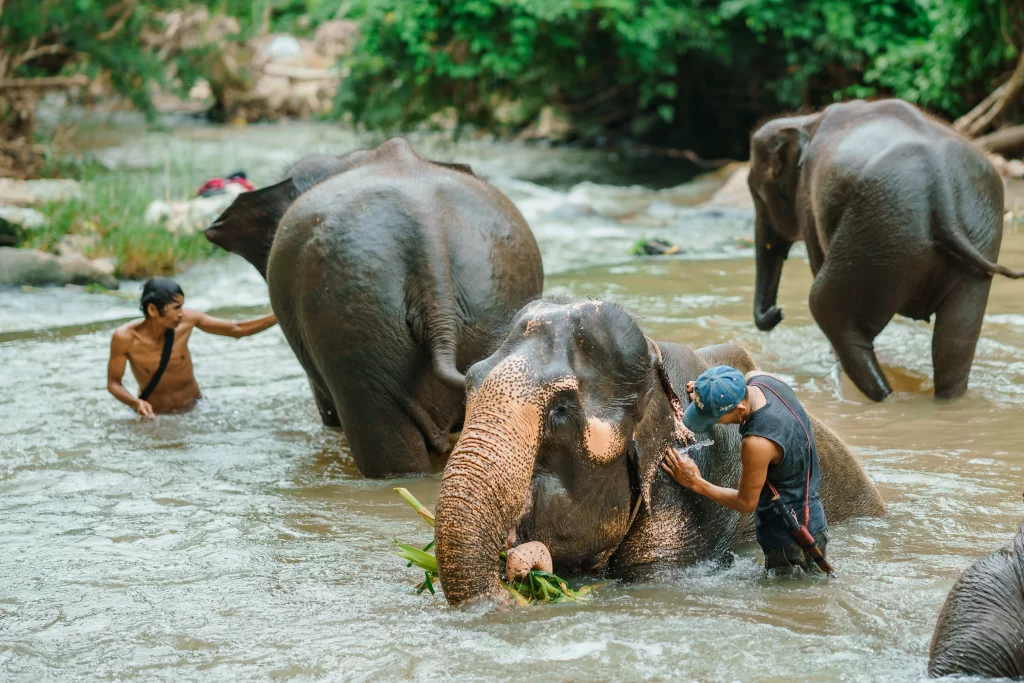
Elephant Jungle Sanctuary Chiang Mai operates under a strict no-ride policy, a foundational principle that separates conservation programs from tourism businesses disguised as rescue centers. The facility retired its elephant-back seating platforms in 2014, two years before Thailand's tourism authority issued nationwide welfare guidelines. Every animal in the 35-elephant herd arrived from logging operations, street begging, or circus work, bearing the physical evidence of training chains and spinal compression. The sanctuary's ethical framework rests on three verifiable standards. First, mahouts use voice commands and positive reinforcement exclusively—no bull hooks, no chains during visitor hours, no confinement outside nighttime shelters. Second, the daily schedule mirrors wild foraging patterns: elephants spend six hours grazing across terraced hillsides before afternoon bathing in spring-fed ponds. Third, veterinary care follows protocols established by the National Elephant Institute, with quarterly health assessments documented in public reports. These practices align with the standards that define responsible elephant tourism in northern Thailand. Visitor interaction happens on the elephants' terms. The morning feeding session provides sugar cane and bananas in open clearings where the herd decides approach distance. Guides intervene if an elephant shows stress signals—flattened ears, trunk tucking, backward steps—and redirect guests to observational distance. The bathing component, often misunderstood as entertainment, serves a welfare function: mud coating protects against insect bites and sun exposure in tropical climates. Mahouts demonstrate proper application technique, but physical contact remains optional and limited to five-minute intervals. The bamboo rafting portion, included in the half-day program, operates on the Mae Taeng River under separate conservation guidelines. Rafts accommodate four passengers maximum to minimize wake disruption in fish-spawning zones. The 45-minute float passes through teak forest corridors where guides identify native bird species and explain watershed management tied to elephant habitat preservation. This dual-activity model funds the sanctuary's operating costs—veterinary supplies, mahout salaries, land lease payments—without relying on government subsidies. Transparency distinguishes ethical operations. The sanctuary publishes elephant biographies with rescue dates, medical histories, and behavioral notes. Visitors review these profiles during the pre-activity briefing at the site's education pavilion. The facility also maintains open communication with Animal Welfare Watch Thailand, submitting to unannounced inspections and third-party welfare audits. These accountability measures provide verification that extends beyond marketing claims, offering travelers concrete evidence of conservation commitment in a region where ethical elephant sanctuary and bamboo rafting Chiang Mai experiences remain inconsistently regulated.
“The no-ride policy, adopted in 2014, remains the clearest indicator separating conservation programs from entertainment venues in northern Thailand.”
The Elephant Jungle Sanctuary prioritizes the well-being of its residents by enforcing strict non-intrusive observation policies. These standards ensure that elephants live in an environment that mimics their natural habitat while prohibiting harmful human-animal interactions.
The sanctuary maintains a strict no-riding policy to prevent physical strain and behavioral distress in elephants. Visitors observe the animals from a respectful distance rather than engaging in physically intrusive activities.
Elephants at the sanctuary are provided with expansive, forested areas that encourage natural behaviors such as foraging and social bonding. This approach helps rehabilitate rescued animals by allowing them to live in a semi-wild environment.
The experience focuses on ethical observation, where guests watch the elephants interact with their environment and each other. This method minimizes stress and allows the animals to maintain their autonomy throughout the day.
The facility is recognized for its commitment to animal welfare by prioritizing the health and needs of the elephants above visitor entertainment. Professional mahouts oversee the daily care to ensure the animals' physical and mental health.
The sanctuary mandates a chain-free and hook-free environment for all elephants in its care. This commitment removes tools often associated with forced training, fostering trust between the elephants and their caretakers.
Many elephants at the sanctuary are rescues from the logging or trekking industries. The program provides these retired animals with a secure environment to recover and socialize without the pressure of performing tasks.
This itinerary suits visitors seeking close contact with rescued elephants under observation-based protocols, followed by traditional river navigation. The combined experience spans approximately 6–7 hours including transfers.
Guides collect participants from Chiang Mai accommodations and drive to the sanctuary site in the surrounding hills, briefing passengers on no-riding and no-bullhook policies during the 60–90 minute journey.
Staff explain each elephant's rescue history and current care routines, then visitors observe the herd's natural foraging behavior from a respectful distance before any direct interaction begins.
Participants prepare fruit and vegetables under keeper supervision, hand-feed the elephants, then assist with mud application—a thermal regulation activity the animals initiate themselves rather than perform on cue.
The group accompanies elephants to a shallow stream where the animals wade and spray water; visitors help rinse mud while keepers monitor stress signals and ensure voluntary participation.
A vegetarian Thai buffet is served in an open-air sala while elephants rest in nearby shade, giving both species recovery time before the afternoon component.
Vehicles transport the group to the Mae Taeng or Mae Wang river put-in point, a 20–30 minute drive depending on water conditions and seasonal access routes.
Two passengers per raft pole downstream for 60–90 minutes through forested banks and agricultural lowlands, with a licensed guide managing navigation and pointing out bird species.
Rafts pull ashore at the designated take-out point where vehicles wait to drive participants back to their hotels, arriving by early evening.
Ethical elephant interaction depends on visitor restraint and respect for natural behavior. Following sanctuary protocols ensures elephants retain autonomy while supporting conservation-focused observation.
Elephant Jungle Sanctuary operates daily to accommodate visitors participating in ethical animal welfare programs and bamboo rafting experiences. Planning your visit requires attention to the recommended arrival window to ensure optimal conditions for jungle activities.
Pack light but strategically for jungle terrain and ethical wildlife interaction.
Everything you need to know about ethical elephant sanctuary and bamboo rafting chiang mai
This location prioritizes the health and well-being of the animals by strictly prohibiting riding, bathing, or performing shows. The programs focus on observation, feeding, and walking alongside the elephants in their natural habitat. Visitors engage in jungle exploration and serene river journeys while supporting conservation-first practices.
Yes, the booking process typically includes coordinated pick-up and drop-off services for guests staying in the Chiang Mai city area. This simplifies logistics for those participating in a combined elephant encounter and water activity. Detailed pickup confirmations are provided during the reservation process.
There are no strict age limits for visiting, but parents should consider that the terrain can be uneven and the day involves active engagement with animals. The facility is suitable for families, though younger children may require supervision near the river and during jungle walks. Always verify specific safety guidelines for water activities when booking.
The sanctuary operates as a rescue and rehabilitation center where elephants are free to roam within protected jungle areas. Ethical practices include allowing the herd to socialize naturally without the use of hooks or forced labor. Professional mahouts monitor the animals to ensure they remain stress-free and healthy.
Guests should pack comfortable clothing that can get dirty, sunscreen, a hat, and insect repellent. Bringing a change of clothes is recommended after spending time near the water or engaging in jungle activities. Footwear with good grip is essential for walking on forest paths.
Entrance fees for the sanctuary start at 1,900 THB. This base rate covers the half-day program, which includes conservation efforts and various activities. Additional costs for specialized tours or private group arrangements may vary.
The best arrival window is between 07:00 and 09:00. Arriving early during this period provides the most comfortable weather for jungle activities before the midday heat intensifies.